
An aircon that runs perfectly can still break a rule. In a residential area of the Western Cape, the noise from it at your property boundary may not go over 50 dBA, day or night. That limit is one of several rules a Cape Town install has to meet, and most of them have nothing to do with how cold the room gets.
This page lists each one: who it binds, what it asks for, and where it is written. We fit split units in homes across the city, and these are the things we check before a bracket goes on a wall.
The short version
- The certificate of conformity for the refrigerant work must come from an SAQCC Gas registered practitioner.
- New wiring needs an electrical certificate of compliance. In some older houses, any addition means a certificate for the whole house.
- Outdoor units in residential areas: 50 dBA at the boundary, or no more than 5 dBA above the background noise.
- In a sectional title complex, the trustees' written consent is likely needed. Buildings older than 60 years may need a heritage permit.
- R22 has been banned from new installs since 2015, and an amended energy-efficiency and labelling specification takes effect from about August 2027.
Every rule on one page
Some of these rules bind the installer and some bind you, the owner or tenant. A few bind manufacturers and never touch your install at all. The table sorts them out.
| Rule | Who it binds | Where it is written |
|---|---|---|
| Certificate of conformity for installing or servicing a refrigeration system (SANS 10147 includes air-conditioning plants), issued by an SAQCC Gas registered practitioner | The installer doing the refrigerant work | Department of Employment and Labour guidance to the Pressure Equipment Regulations, GN 1265 of 2017, note (g) |
| Electrical certificate of compliance for at least any addition or alteration to the wiring | The user or lessor of the installation (you, or your landlord) | Electrical Installation Regulations, 2009, regulation 7(4) |
| Certificate for the WHOLE installation after any addition, if it dates from before 23 October 1992 and the property has not changed hands since 1 March 1994 | The user or lessor | Electrical Installation Regulations, 2009, regulation 7(3) |
| Electrical installation work done as a contractor only by a registered electrical contractor | Whoever does the wiring | Electrical Installation Regulations, 2009, regulation 6(1) |
| No more than 50 dBA at the property boundary, or 5 dBA above the residual noise, in a residential area | The person using the aircon | Western Cape Noise Control Regulations, 2013, regulation 5 |
| Trustees' written consent to change the outside look of a section, or to drive screws into common property | Owners and occupiers in a sectional title scheme | Prescribed conduct rules 4(1) and 5(1), unless your scheme replaced them |
| Heritage Western Cape permit for any alteration to a building older than 60 years | The owner (whether an aircon counts as an alteration is not stated) | City of Cape Town heritage page |
| No R22 or other HCFC refrigerant in a new air-con installation, from 1 January 2015 | Anyone installing a new system | Ozone-depleting substances regulations, regulation 5(2)(c) |
| Amended energy-efficiency and labelling specification, Phase 1 from about August 2027 | Manufacturers and importers, not installers or units already on your wall | VC 9008, GN 7859 of 2026 |
The gas side: SAQCC Gas and the certificate of conformity
The paperwork for the refrigerant runs through SAQCC Gas. The Department of Employment and Labour has appointed it to register practitioners in four gas industries, and air conditioning and refrigeration gas is one of them.
The link to your aircon is a guidance note the department published in 2017. Under the Pressure Equipment Regulations, it says the certificate of conformity for installing or servicing a refrigeration system must come from an SAQCC Gas registered practitioner. The standard it names, SANS 10147, covers "refrigerating systems including plants associated with air-conditioning systems", and applies to every system holding more than 150 g of refrigerant.
SAQCC Gas's own summary puts it more broadly: anyone working on a gas system must be trained and registered with SAQCC Gas, which administers this for the Department of Employment and Labour. In the regulations, an "authorised person" is someone registered as competent for that scope of work.
The electrical side: when you need a certificate of compliance
If fitting the aircon means a new circuit or any other change to your wiring, regulation 7(4) of the Electrical Installation Regulations applies: the user or lessor must get a certificate of compliance for at least the addition or alteration. The person doing that work as a contractor has to be a registered electrical contractor.
Older houses have an extra rule. If the wiring dates from before 23 October 1992 and the property has not changed ownership since 1 March 1994, any addition or alteration means a certificate for the whole electrical installation, not just the new circuit. On a house like that, a small aircon job can mean certifying the whole house's wiring, so raise it before you get a price.
Which electrical certificate the install triggers
Most houses
- Certificate of compliance for at least the addition or alteration
- Obtained by the user or lessor
- Electrical Installation Regulations, regulation 7(4)
Wired before 23 October 1992, same owner since 1 March 1994
- Any addition or alteration triggers a certificate for the WHOLE installation
- Obtained by the user or lessor
- Electrical Installation Regulations, regulation 7(3)
Electrical Installation Regulations, GN R.242 of 6 March 2009.
One more electrical point comes from a supplier rather than the law. A Gauteng distributor of Samsung aircons says in its FAQ that an isolator switch within 2 m of the outdoor unit, and in view of it, is a regulation requirement. We have not read the wiring standard it relies on, so treat that as the distributor's requirement and ask your electrician.
Noise: 50 dBA at your boundary
The Western Cape Noise Control Regulations of 2013 name air-conditioning equipment outright, next to pool pumps and refrigeration units. In a residential area, none of them may be used if the noise on the property projection plane goes over 50 dBA, or goes more than 5 dBA above the residual noise. The projection plane is the boundary line of the premises, so the reading is taken where your property meets your neighbour's.
The noise rule for aircons in residential areas
Western Cape Noise Control Regulations, P.N. 200/2013, regulation 5.
The limit has an exception only where the local authority authorises the noise or in an emergency. And because it is a provincial regulation, it applies in every municipality in the Western Cape; in Cape Town, the City is the local authority that applies it. Its 2019 guide for ventilation plans quotes the same figure: at most 50 dBA on the boundary for residential applications.
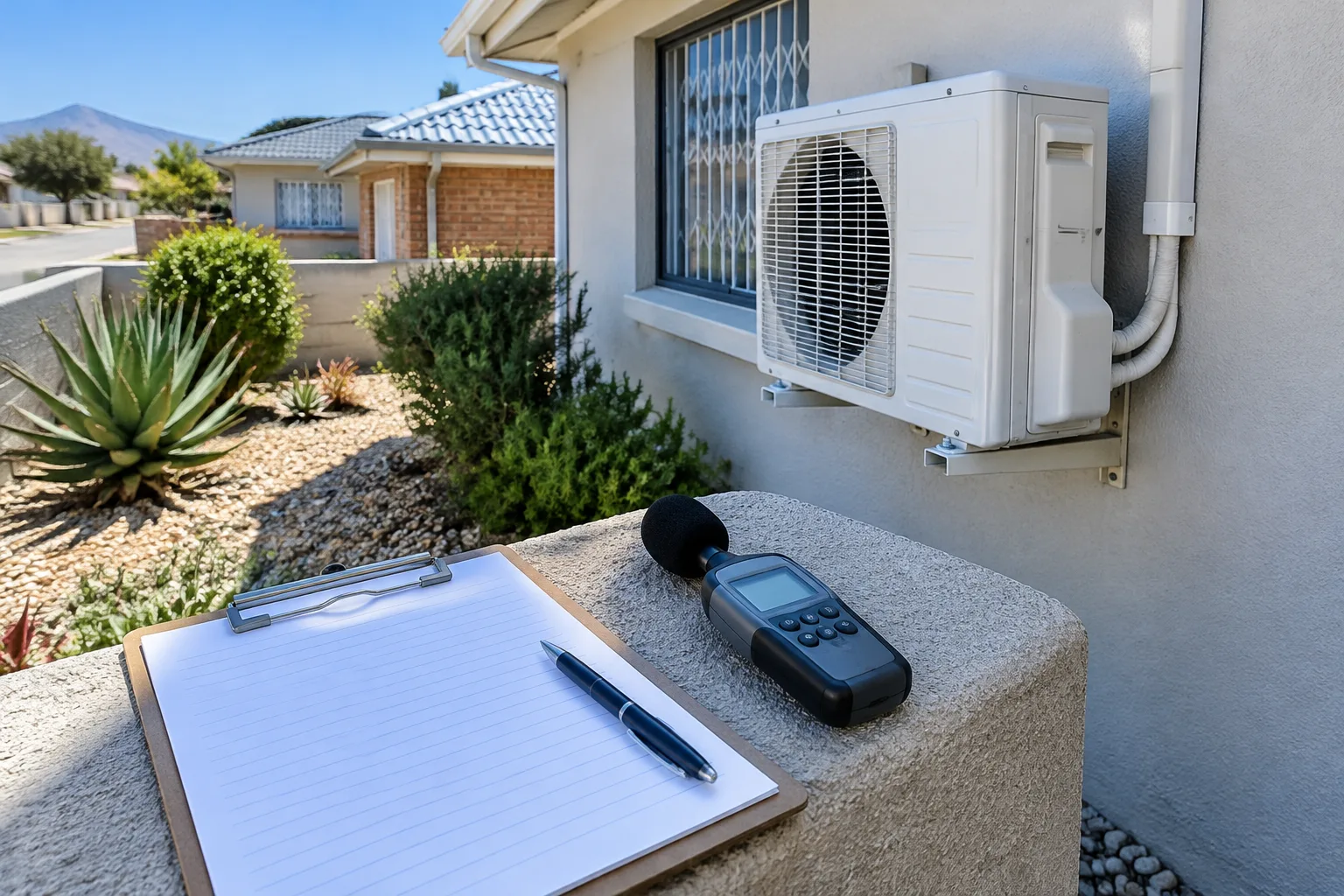
The City's own noise nuisance by-law never mentions air conditioners. Do not read that as a pass: its section 3 covers noise from a home that can be heard in a public place. Where the outdoor unit goes, and which way it blows, is the part we plan on site, especially on narrow plots where the side wall is the boundary.
Sectional title: the trustees come first
In a complex, the default conduct rules for sectional title schemes cover the two things an outdoor unit does. Rule 5(1) says you need the trustees' written consent to change the external appearance of your section or exclusive use area, unless the change is minor and does not detract from it. Rule 4(1) says the same for driving nails or screws into a structure that is common property.
Neither rule names air conditioners, but a wall-mounted outdoor unit does both of those things, so it likely needs trustee consent. Schemes can adopt their own rules, so check your scheme's rules before you book anyone.
Who to ask before the install
Freehold house
- No trustee consent involved
- Still bound by the 50 dBA boundary rule
- Heritage permit may apply if the building is older than 60 years
Sectional title unit
- Trustees' written consent is likely needed for the outdoor unit
- Brackets on common property walls fall under rule 4(1)
- Your scheme may have replaced the default rules
Older or protected building
- Over 60 years old: a Heritage Western Cape permit is needed for any alteration
- In a Heritage Protection Overlay zone: Chapter 20 of the planning by-law
- Ask the City's heritage office whether your install counts
Heritage: buildings older than 60 years
The City of Cape Town's heritage page says a permit from Heritage Western Cape is required for any alteration to a building older than 60 years. It does not say whether mounting an aircon counts, so a house of that age may need one. Properties inside a Heritage Protection Overlay zone have to follow Chapter 20 of the City's Municipal Planning By-law for alterations.
On building plans, we found no City statement either way on whether a single domestic split unit needs them. If your install is large or unusual, ask the City before work starts.
Refrigerant: R22 is out of new installs, and the rest is shrinking
Since 1 January 2015, South Africa's ozone regulations have prohibited using R22, or any refrigerant containing HCFCs, in the installation of a new air-conditioning system. Importing air-con equipment that contains R22 stopped from 1 July 2014.
| When | What the regulations say |
|---|---|
| From 1 July 2014 | No importing new or used air-con equipment containing R22 or any HCFC refrigerant |
| From 1 January 2015 | No R22 or other HCFC in the installation of any new air-con system |
| 2026 to 2030 | HCFC consumption may not exceed 2.5% of the baseline (all HCFCs, not R22 alone) |
| From 2031 | That 2.5% may only be used for servicing |
| By 2040 | No importing, selling or using HCFCs at all |
If you still run an old R22 unit, that means the gas it was built for is down to 2.5% of the baseline for every HCFC combined. The Department of Forestry, Fisheries and the Environment said on World Ozone Day 2025 that some of the HCFCs and HFCs used in air conditioners are being phased down. Before you spend on an old R22 system, talk to us about repairing or regassing an older unit and whether replacing it makes more sense.
The refrigerant dates in three numbers
Regulations regarding the phasing-out and management of ozone-depleting substances, regulation 5.
The amended energy label: gazetted, not in force yet
On 28 August 2026 the government gazetted an amended VC 9008, the compulsory specification for energy efficiency and labelling. It covers window, wall, ceiling, floor, ducted, portable and split-system air conditioners up to 16 kW (55 000 btu/h) of cooling. Phase 1 takes effect 12 months after publication and Phase 2 after 24 months, which by our count is about August 2027 and about August 2028.
The amended specification binds manufacturers and importers. It does not change anything for installers or for a unit already on your wall, and it also requires refrigerants in air conditioners to comply with the environment department's latest refrigerant regulations. For what a unit costs to run in the meantime, our guide on sizing an aircon and working out its running cost uses the City's 2026/27 tariffs.
What to check before you sign a quote
Ask these before the install date
- Is the installer who will do the work SAQCC Gas registered? Ask for the card and check the name.
- Will the job add or alter wiring, and who issues the electrical certificate of compliance?
- If the house was wired before 23 October 1992, has it changed hands since 1 March 1994?
- Where will the outdoor unit sit relative to the boundary and the neighbours' windows?
- In a complex: do you have the trustees' written consent?
- Never accept a new install charged with R22. It has been prohibited since 2015.
We go through these points when we quote for a home aircon installation. To see how published Cape Town install prices compare before you ask, our aircon installation cost page lists them source by source.
Once the unit is in, keep the certificates with your house papers and book regular aircon servicing, since a service is gas work too. When you are ready, send us your room and suburb for a quote. It costs nothing to ask.