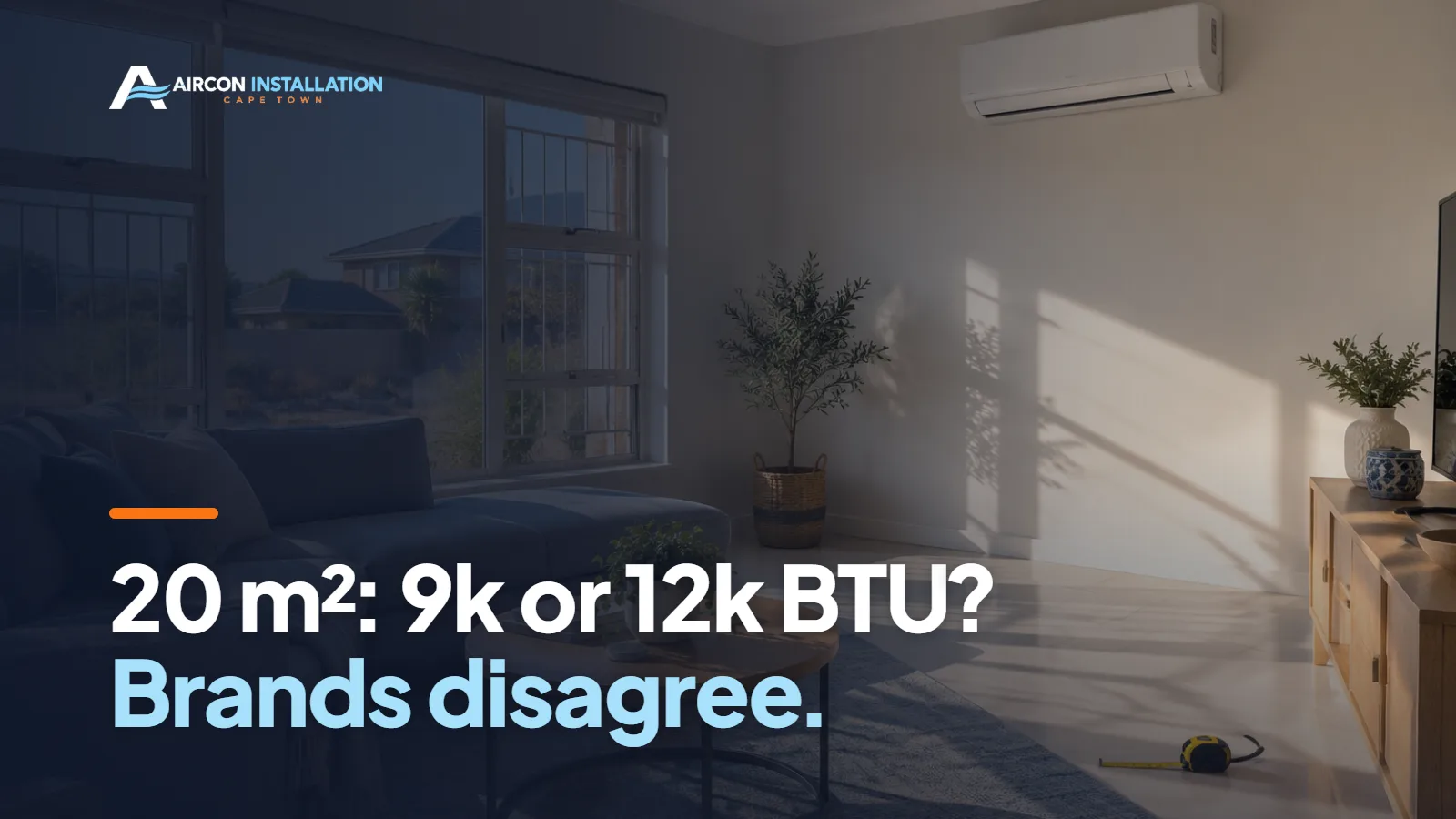

Look up a 20 m² bedroom in three South African aircon guides and you get two answers. LG South Africa's chart puts 20 m² on the line between 9 000 and 12 000 BTU. Midea's table and Samsung Air's worked example both say 12 000 BTU. Each publishes its own guideline, and none of them has seen your room.
This guide puts the three side by side exactly as published, then works out the part nobody can publish for you: what your unit will cost to run on the City of Cape Town's 2026/27 tariffs.
What to take from this
- Measure the floor area first. Every brand table works from square metres.
- LG, Midea and Samsung Air give overlapping but different bands. Read one table at a time, never an average.
- Running cost = input power (kW, from the unit's label) × hours = kWh, then kWh × your tariff.
- City Home User tariff, 2026/27: 355.95 c/kWh up to 600 kWh a month and 469.06 c above, including VAT.
- At Cape Town International Airport, February averages the warmest afternoons (27.3 °C) and July the coldest nights (7.4 °C).
Start with the floor area
Every sizing table below works from floor area in square metres: length times width. Samsung Air, a Gauteng distributor of Samsung units, uses a 5 m by 4 m room as its 20 m² example. Area is only the starting point. LG lists four things that decide the size: room size, insulation, sunlight exposure and ceiling height.
| Unit size | LG South Africa | Midea South Africa | Samsung Air (Gauteng distributor) |
|---|---|---|---|
| 9 000 BTU | 15 to 20 m² | 15 to 18 m² | not given |
| 12 000 BTU | 20 to 30 m² | 20 to 25 m² | example: 20 m² |
| 18 000 BTU | 30 to 40 m² | 30 to 35 m² | not given |
| 24 000 BTU | 40 to 60 m² | 40 to 45 m² | example: 40 m² |
| 30 000 BTU | not listed | 55 to 60 m² | not given |
| 36 000 BTU | 60 to 80 m² | not listed | not given |
| Larger areas | not listed | installer to advise | not given |
Each column is copied from its own source and nothing is filled in between. Samsung Air's rule of thumb is roughly 600 BTU per square metre; the two room sizes shown are its own worked examples.
Room area each brand gives per unit size (m²)
- LG, 9 000 BTU15 to 20 m²
- Midea, 9 000 BTU15 to 18 m²
- LG, 12 000 BTU20 to 30 m²
- Midea, 12 000 BTU20 to 25 m²
- LG, 18 000 BTU30 to 40 m²
- Midea, 18 000 BTU30 to 35 m²
- LG, 24 000 BTU40 to 60 m²
- Midea, 24 000 BTU40 to 45 m²
LG Electronics South Africa sizing chart; Midea South Africa (Livance) help centre. Both read 9 November 2026.
Where the tables disagree
LG's bands are wider and run continuously, so every room from 15 to 80 m² lands somewhere. Midea's bands are narrower and stop short: its table says nothing about rooms of 18 to 20 m², 25 to 30 m², 35 to 40 m² or 45 to 55 m². A 27 m² lounge is 12 000 BTU on LG's chart and has no row on Midea's. At 55 to 60 m² they part ways: LG's 40 to 60 m² band says 24 000 BTU, while Midea's 55 to 60 m² band says 30 000 BTU.
Hirsch's, a retailer with Cape Town branches, says in its installation terms that its warranty is not valid if the unit is too small for the area. That is why we measure the room and look at the windows, the ceiling and the insulation before we name a size, as set out in how our installs work.
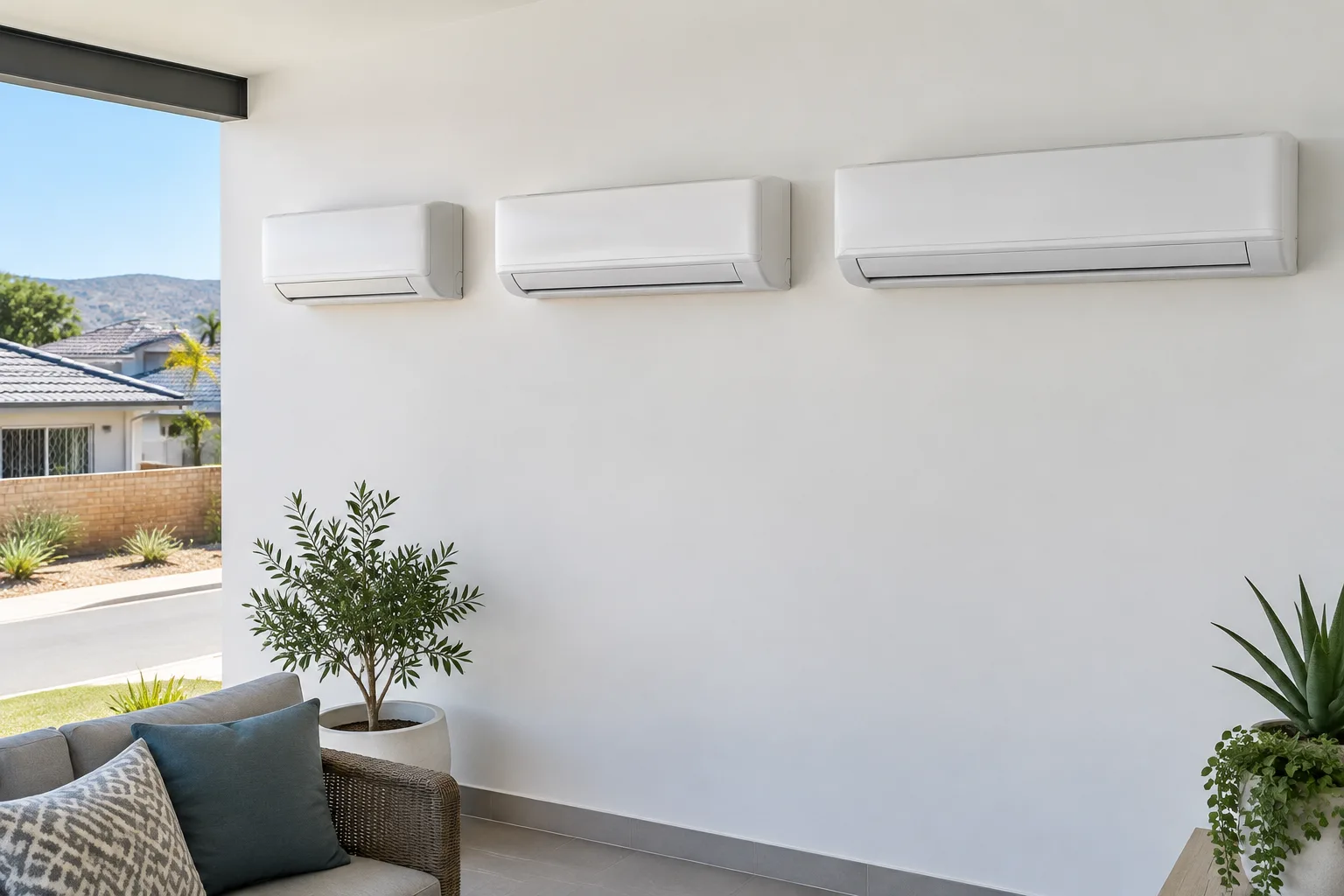
LG's chart stops at 80 m² and Midea leaves larger areas to an installer. Big open-plan spaces, shops and offices are a conversation for office and larger-space installs rather than a chart.
What it costs to run: the arithmetic
An aircon's running cost comes down to two numbers you can find yourself. The first is the input power on the unit's rating label, in watts or kilowatts. The second is your electricity tariff per kilowatt-hour (kWh). We do not quote a running cost for you, because we have not seen your unit's label.
| Step | What to do |
|---|---|
| 1. Read the label | Find the input power. If it is in watts, divide by 1 000 to get kW. |
| 2. Energy used | kW × hours of use = kWh |
| 3. Cost in cents | kWh × your tariff in c/kWh (for example 355.95 c on the Home User tariff, up to 600 kWh) |
| 4. Cost in rands | Divide the cents by 100 |
Use the rated input power exactly as the label prints it. Midea's South African distributor claims non-inverter units consume up to 40% more electricity than inverters. That is a manufacturer's claim; we found no independent figure to test it against.
The City of Cape Town tariffs for 2026/27
The City's 2026/27 residential tariffs have been in effect since 1 July 2026, for customers in the City of Cape Town supply area. If Eskom supplies your area, the rates differ and the City refers you to Eskom. These are the energy charges for the two common household tariffs.
| Tariff and block | Excluding VAT | Including VAT |
|---|---|---|
| Home User, up to 600 kWh a month | 309.52 c/kWh | 355.95 c/kWh |
| Home User, above 600 kWh a month | 407.88 c/kWh | 469.06 c/kWh |
| Home User, Services and Wires Charge | R368.96 per month | R424.30 per month |
| Domestic (prepaid, property valued R500 000 to R1 million), up to 600 kWh | 359.82 c/kWh | 413.79 c/kWh |
| Domestic, above 600 kWh | 429.48 c/kWh | 493.90 c/kWh |
Source: City of Cape Town, "The cost of electricity", read 9 November 2026. The Domestic tariff also carries a fixed monthly Services and Wires charge, listed on the City's page and not repeated here.
Home User tariff, including VAT
City of Cape Town 2026/27 residential tariffs, in effect from 1 July 2026, City supply area only.
The blocks matter for an aircon. On both tariffs the rate steps up once a month's use passes 600 kWh, so the hours an aircon adds in a busy month can be charged at the higher rate. The Services and Wires Charge is a fixed monthly amount, so running the aircon does not change it.
Cape Town's climate, month by month
How many hours you run the unit depends on the weather. The official long-term figures we use are the WMO's 1991 to 2020 climate normals for Cape Town International Airport. They describe the airport on the Cape Flats only, so do not read them as figures for coastal suburbs.
Mean daily maximum temperature, °C (Cape Town International Airport, 1991-2020)
- 27Jan
- 27.3Feb
- 26Mar
- 23.6Apr
- 20.6May
- 18.2Jun
- 17.9Jul
- 18Aug
- 19.6Sep
- 22.2Oct
- 23.7Nov
- 25.8Dec
WMO 1991-2020 climate normals, station 68816, via NOAA NCEI. Annual mean daily maximum: 22.5 °C.
Average rainfall, mm (Cape Town International Airport, 1991-2020)
- 9.4Jan
- 9.6Feb
- 12.5Mar
- 40.1Apr
- 61.1May
- 92.3Jun
- 84.8Jul
- 72.4Aug
- 44.3Sep
- 28.4Oct
- 25.3Nov
- 12.8Dec
WMO 1991-2020 climate normals, station 68816, via NOAA NCEI. Annual total: 492.8 mm.
January and February average the warmest afternoons, at 27.0 °C and 27.3 °C. These are averages of daily highs, so some days run hotter and some cooler. In winter, July's nights average 7.4 °C and June is the wettest month, at 92.3 mm. A reverse-cycle split heats as well as cools, which is the case for using an aircon as winter heating.
| Month | Mean daily max (°C) | Mean daily min (°C) | Rain (mm) |
|---|---|---|---|
| Jan | 27.0 | 16.6 | 9.4 |
| Feb | 27.3 | 16.5 | 9.6 |
| Mar | 26.0 | 15.0 | 12.5 |
| Apr | 23.6 | 12.2 | 40.1 |
| May | 20.6 | 10.2 | 61.1 |
| Jun | 18.2 | 8.1 | 92.3 |
| Jul | 17.9 | 7.4 | 84.8 |
| Aug | 18.0 | 7.9 | 72.4 |
| Sep | 19.6 | 9.4 | 44.3 |
| Oct | 22.2 | 11.5 | 28.4 |
| Nov | 23.7 | 13.4 | 25.3 |
| Dec | 25.8 | 15.6 | 12.8 |
| Year | 22.5 | 12.0 | 492.8 |
The same station logs 3 115 hours of sunshine a year on average. WMO 1991-2020 normals, Cape Town International Airport (station 68816).
Putting it together before you buy
The brand you settle on decides more than which sizing table to read. Its warranty conditions come with the unit. Samsung Air says its Samsung midwall splits carry a 5-year warranty only if an installation company it has authorised fits the unit, the unit is serviced as the warranty card sets out, and you register it online. LG South Africa's warranty table lists 10 years on the compressor of selected inverter models and 5 years on selected constant-speed models, for parts only, with labour charged.
So before you fix on a size, read the warranty terms for that exact model and ask who will fit and service it. A unit sized from the right table but fitted by the wrong installer can fall outside the warranty its brand advertises. On your quote, ask about the warranty on both the unit and the work.
Before you choose a size
- Measure length and width, and note the ceiling height, the windows and how much sun the room gets.
- Read one brand's table at a time, the brand you are buying.
- Check the input power on the rating label and do the kWh sum with your own tariff.
- Find out whether you are a City or an Eskom customer before using the City's rates.
- Do not average the brand tables, and do not fill a gap in one with a guess.
The unit is only part of the spend. Our guide to aircon installation prices in Cape Town covers what the install itself costs, and the paperwork side, from the gas certificate to the 50 dBA noise limit, is in our rundown of Cape Town aircon rules.
Hirsch's makes all its warranties subject to an annual service, and manufacturers set their own conditions, so plan for a yearly aircon service. When you have the room measurements, ask us to size and price it. Asking costs nothing.