Homes
Home aircon installation in Cape Town
A wall-mounted split has two halves: an indoor unit high on the wall and an outdoor unit on a bracket outside, joined by refrigerant piping, a drain pipe and a cable that pass through one drilled hole.
Bolting those up is the easy part. Choosing the size, finding the right spot for the outdoor unit and getting the paperwork right take more thought, and this page covers all three.
Call 060 016 7019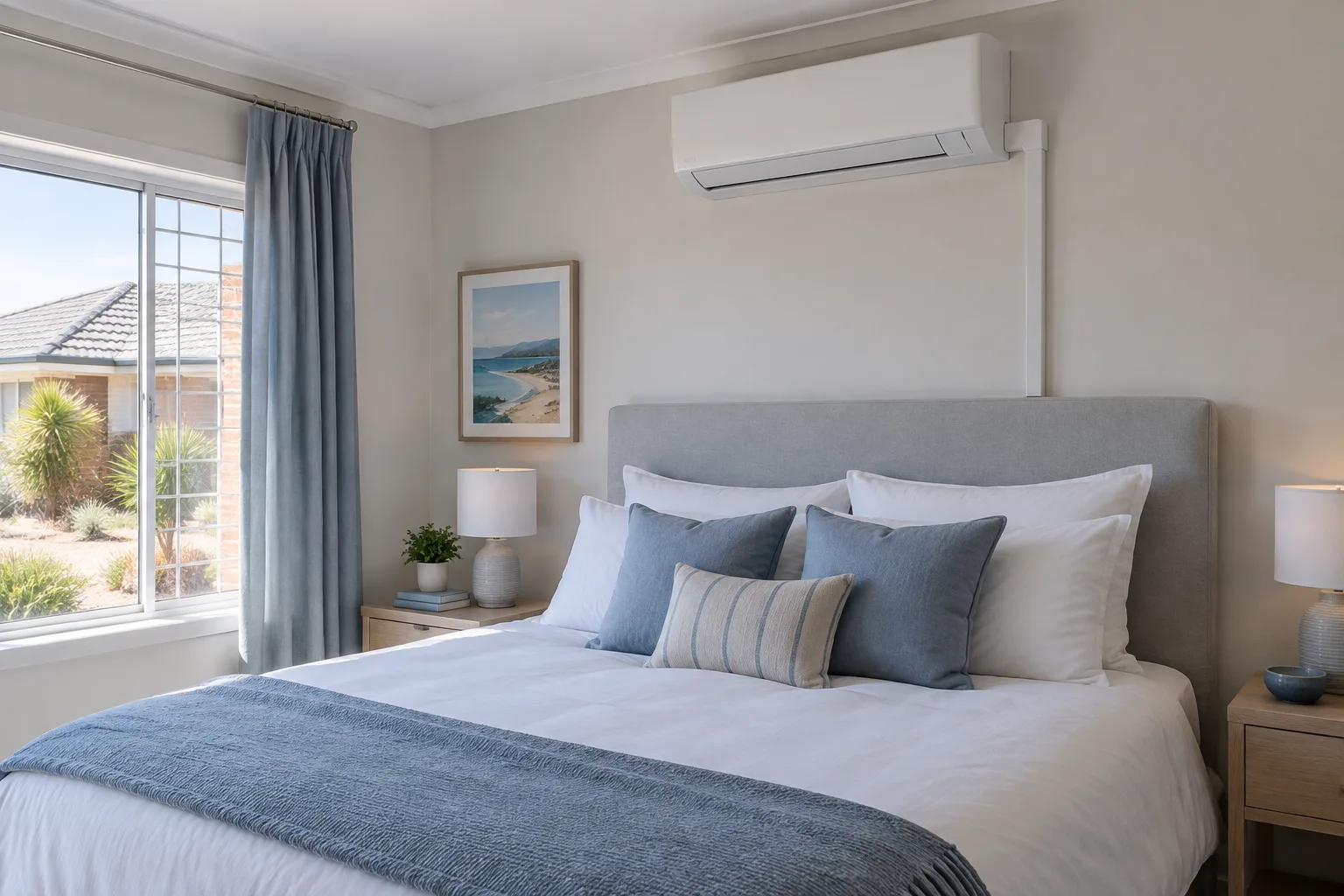
The two certificates
The refrigerant side comes first. Under the Pressure Equipment Regulations, the Department of Employment and Labour's guidance says the certificate of conformity for installing or servicing a refrigeration system must come from an SAQCC Gas registered practitioner. The standard it names, SANS 10147, covers refrigerating systems including plants associated with air-conditioning systems. SAQCC Gas registers practitioners in air conditioning and refrigeration gas on the department's behalf.
The installer who does the work must be SAQCC Gas registered. Ask to see the card, and you can check it on SAQCC Gas's public practitioner search.
The electrical side is separate. If the unit gets its own new circuit, the Electrical Installation Regulations say the owner or lessor must obtain a certificate of compliance for at least that addition, and only a registered electrical contractor may do electrical installation work as a contractor.
Older houses need one extra check. If your wiring went in before 23 October 1992 and the property has not changed hands since 1 March 1994, any addition, a new aircon circuit included, means a certificate of compliance for the whole installation. Tell us the age of the house when you ask for a quote so this doesn't come as a surprise on the day.
Where the outdoor unit goes
The outdoor unit is the noisy half, and the Western Cape has a number for it. The province's Noise Control Regulations of 2013 say air-conditioning equipment in a residential area may not make more than 50 dBA on the property boundary, or more than 5 dBA above the background noise there. The rule applies across the province and is enforced locally. The City's own noise nuisance by-law doesn't name aircons, but it does deal with noise from a home that can be heard in a public place.
In practice that means we don't bolt a condenser to the wall that faces your neighbour's bedroom window if another wall will do. On a semi-detached house or a narrow plot the side wall may be the only option, so we talk through the boundary before drilling, whether the house is in Durbanville or anywhere else in the city.
Placement also sets the pipe length, and published price lists charge extra copper by the metre. Our aircon installation cost guide sets those charges out source by source.
Flats, townhouses and older buildings
In a sectional-title scheme, two of the default conduct rules matter. Rule 4 says you need the trustees' written consent to drive screws into a structure that is common property, which is what a bracket on an outside wall does. Rule 5 needs their written consent to change the external appearance of your section, unless the change is minor. Neither rule names aircons, but an outdoor unit likely needs trustee consent. Schemes can replace the default rules, so check your scheme's rules and get the letter before we book a date.
For freestanding homes, the City says a Heritage Western Cape permit is needed for any alteration to a building older than 60 years. The City page doesn't say whether mounting an aircon counts, so an older house may need one. Ask the City's heritage office if yours is that age.
Replacing an old unit? Since 1 January 2015 the regulations have banned R22, or any refrigerant containing HCFCs, in the installation of a new air-conditioning system, whatever was on the wall before. If the old unit still runs, our page on keeping a split serviced may be the better place to start.
Sizing: three brands, three answers
Manufacturers publish sizing guides, and they don't line up. Here are three as printed, each with its own room bands in brackets. Samsung Air gives a rule of thumb and two worked examples, so its column shows only those examples. We haven't filled any gaps.
| Room size | LG South Africa | Midea SA | Samsung Air (worked examples) |
|---|---|---|---|
| 15 to 20 m² | 9 000 BTU (15 to 20 m²) | 9 000 BTU (15 to 18 m²) | No example given |
| 20 to 30 m² | 12 000 BTU (20 to 30 m²) | 12 000 BTU (20 to 25 m²) | 12 000 BTU at 20 m² |
| 30 to 40 m² | 18 000 BTU (30 to 40 m²) | 18 000 BTU (30 to 35 m²) | No example given |
| 40 to 60 m² | 24 000 BTU (40 to 60 m²) | 24 000 BTU (40 to 45 m²); 30 000 BTU (55 to 60 m²) | 24 000 BTU at 40 m² |
| 60 to 80 m² | 36 000 BTU (60 to 80 m²) | Installer to advise | No example given |
Sources: LG Electronics South Africa sizing chart; Midea South Africa (Livance) help centre, which also says larger areas need an installer to advise; Samsung Air, a Samsung distributor, whose rule of thumb is about 600 BTU per m². All read 9 November 2026.
LG lists room size, insulation, sunlight and ceiling height as the things that change the answer. In Cape Town it's the north- and west-facing rooms that take the sun. A wrong size can also cost you warranty cover: one retailer with Cape Town branches says in its installation terms that its warranty is not valid if the unit is too small for the area, and Livance's general warranty excludes problems arising from improper installation.
Our guide to aircon sizes and running costs works through a few room shapes. Before installing anywhere, from a family home in Somerset West to a flat in town, we measure the room ourselves, and the rules that apply to aircons in Cape Town are collected in one place on the blog.
Home installation questions
Tell us about the room
Send the room size, which way it faces and where the outdoor unit could go. It costs nothing to ask for a quote, and you can ask about the warranty on your quote.
Request a quote